

Master Football Techniques with Professional Training
- Oct 3, 2025
- 4 min read
American football demands a unique combination of athleticism, mental focus, and technical skill. Whether you are a beginner learning the fundamentals or an experienced player looking to sharpen your edge, mastering core football techniques is essential for success on the field.
Professional football training provides structured guidance, focused repetitions, and expert feedback that help players develop these skills more efficiently. This article breaks down the value of structured training, highlights essential techniques to master, and explains how to integrate football skills training into your routine.
Why Professional Football Training Matters
Unlike casual pick-up games or backyard practice, professional training sessions are planned with purpose. Coaches analyze each player’s strengths and weaknesses, then design drills that target specific areas for improvement. This structure helps athletes build skills in a way that transfers directly to game situations.
Key Benefits of Professional Training
Improved Football IQ – Learn to recognize defensive coverages, offensive formations, and game situations more quickly.
Refined Technique – Repetition under the guidance of a coach helps clean up footwork, hand placement, and body positioning.
Position-Specific Development – Whether you’re a quarterback, receiver, defensive back, or lineman, drills are tailored to the skills your role requires.
Efficient Progress – Structured sessions make the most of your training time by focusing on high-impact fundamentals.

Core American Football Techniques to Master
Developing as a player starts with mastering the fundamentals. These core techniques apply across multiple positions and levels of play.
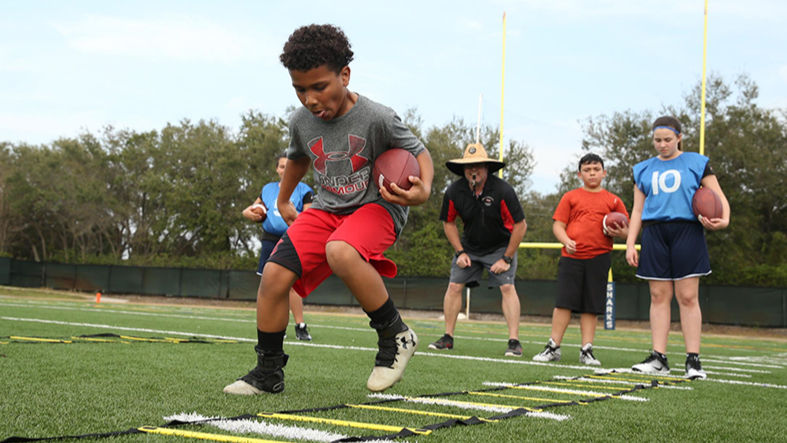
1. Footwork and Agility
Clean footwork is the foundation of nearly every position in football.
Receivers and defensive backs rely on quick breaks and smooth transitions to gain or deny separation.
Quarterbacks use consistent footwork to time their drops and throws.
Defenders need disciplined steps to take proper pursuit angles.
Drills like ladder work, cone patterns, and reaction-based movement improve quickness and control.
2. Route Running and Coverage Technique
For skill positions, precise movement is everything.
Receivers should focus on route depth, sharp breaks, and timing to create separation.
Defensive backs need to master backpedaling, flipping hips, and mirroring receivers without losing balance.
Practicing these techniques in controlled reps builds consistency on game day.
3. Catching and Ball Security
Every offensive player benefits from clean catching technique and strong ball control.
Work on hand placement (diamond for above-the-chest, pinkies together for below).
Practice catching in traffic, over the shoulder, and while on the move.
Emphasize tucking the ball away quickly and maintaining five points of contact to reduce fumbles.
4. Throwing Mechanics and Timing (for Quarterbacks)
Quarterbacks must develop a repeatable throwing motion, proper weight transfer, and strong field vision.
Drill different types of throws — quick game, intermediate routes, deep balls, and on-the-move passes.
Emphasize timing with receivers and understanding defensive leverage.
Work on quick reads to speed up decision-making under pressure.
5. Tackling and Defensive Fundamentals
Sound tackling is about technique and positioning.
Keep your head up, maintain a strong base, and drive through contact.
Work on pursuit angles and breakdown technique to avoid overcommitting.
Practice open-field tackling and group pursuit to sharpen team defense.
6. Physical Conditioning
Football requires repeated bursts of explosive movement over the course of a game.
Sprint work, change-of-direction drills, and core training improve performance and durability.
Position-specific conditioning ensures players can execute their roles at full speed deep into the game.
7. Tactical and Situational Awareness
Understanding the flow of the game is just as important as physical ability.
Study offensive and defensive concepts, down-and-distance tendencies, and coverage shells.
Use film sessions to learn how to identify cues pre-snap and react effectively post-snap.
Simulating real game situations in practice builds confidence and speed of play.
Developing Skills Outside of Tackle Football
Improvement doesn’t have to be limited to the tackle season. Flag football and 7-on-7 formats provide valuable opportunities for players to work on their craft in a different environment.
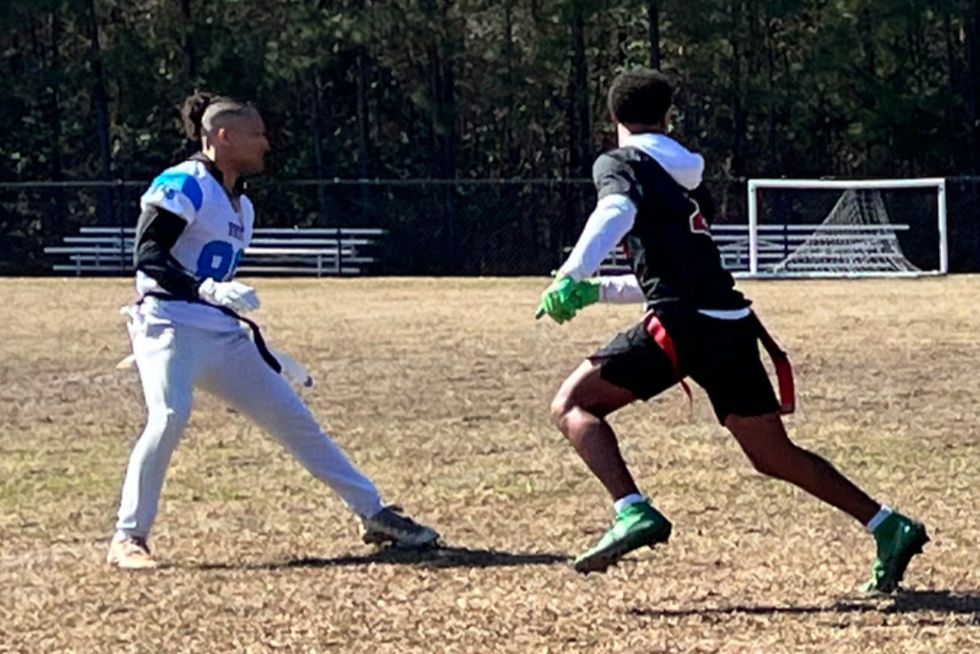
Flag Football allows players to focus on footwork, route running, defensive positioning, and quick decision-making without the physical demands of tackling. Because there’s less contact, athletes get more reps in space, which helps sharpen skills like reading defenses, adjusting routes, and pulling flags with good angles and technique.
7-on-7 Football emphasizes timing, precision, and coverage recognition. With no offensive or defensive line, quarterbacks learn to get the ball out quickly, receivers work on beating coverage with clean routes, and defenders improve their ability to read routes and react in open space. The pace of 7-on-7 also builds communication and chemistry among teammates.
Both formats are excellent for developing fundamentals, mental processing, and football IQ in a controlled, competitive setting. Many players use these opportunities to refine skills that directly translate back to tackle football.

Integrating Football Skills Training Into Your Routine
Consistent, structured practice is what separates average players from great ones. Here’s how to make football training a regular part of your development:
Set Clear Goals – Focus on specific improvements, such as running cleaner routes, making quicker reads, or improving defensive footwork.
Establish a Regular Schedule – Block out weekly time for focused skill work, not just scrimmages.
Warm Up Properly – Dynamic movement prepares the body and helps prevent injury.
Track Your Progress – Keep notes or film to measure improvements in speed, accuracy, and technique.
Target Weak Areas – Spend extra time on footwork, hand placement, or any skills that lag behind.
Simulate Game Scenarios – Run situational drills (e.g., third and long, red zone) to build decision-making under pressure.
Elevate Your Game Through Consistent Development
Mastering football techniques takes repetition, structure, and a willingness to keep improving. Professional training, combined with alternative formats like flag and 7-on-7, provides the perfect environment to build skills and sharpen your mental approach to the game.
By committing to a structured routine, focusing on core fundamentals, and finding ways to develop year-round, players can elevate their performance and gain a deeper understanding of the game. Whether your goals involve competing at a higher level or simply becoming a more complete player, disciplined skills training is the foundation for long-term growth.



Comments